The Leedy Drum Company
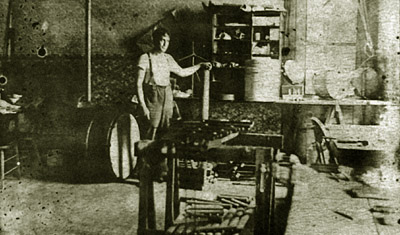
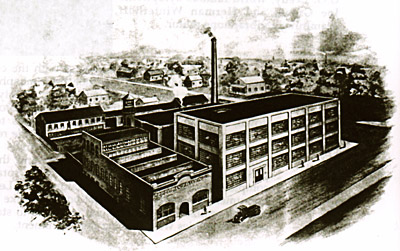
The strength of the Leedy legacy stands as a tribute to the founder, Ulysses G. Leedy. U.G. Leedy began his career as a professional percussionist in the 1890s. His personal need for instrument improvements led him to begin crafting his own. A good example is his first product, the folding drum stand. (Snare drums were hung on slings or placed on chairs until Leedy developed the stand.) Fellow musicians, quick to recognize the value and quality of Leedy,s creations, convinced him to start a business. With only $50.00 startup cash, Leedy set up a small shop in his Indianapolis apartment in 1898 and began making snare drum stands, then snare drums. Within two years he was able to buy four lots and build his first factory building.
Below: Leedy's First Shop:
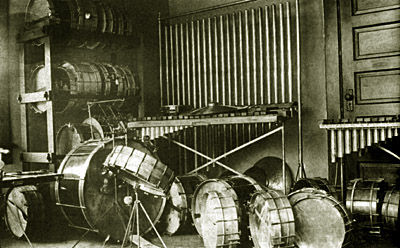
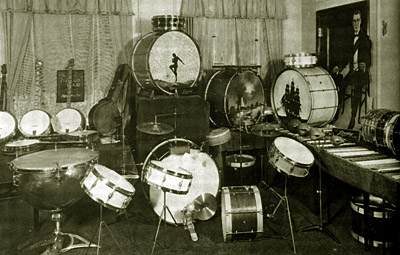
Below: Early Leedy Products:
Below: Leedy Factory Circa 1910:
The success of his business caused U.G. Leedy to curtail his professional career, although he continued to play an occasional concert, and gave free lessons to youngsters at his home on Saturdays. The Leedy product line quickly grew to include drum heads, xylophones, orchestra bells, and accessories. The factory expansions were almost continuous and the products became more widely distributed when Leedy began to wholesale his gear to shops across the country. One such shop was the one owned by William F. and Theo Ludwig; the exclusive Leedy sales agents in Chicago.
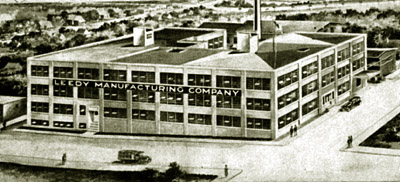
By 1920, Leedy annual sales were in excess of $250,000.00 and as the world,s largest manufacturer of percussion equipment, Leedy made it all. Except for cymbals, the Leedy Drum Company manufactured everything that it sold, which was a claim no other company could make.
Below: Leedy Factory Circa 1920:
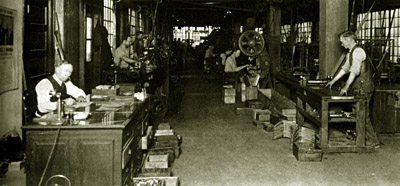
Below: Leedy Machine Shop Circa 1925:
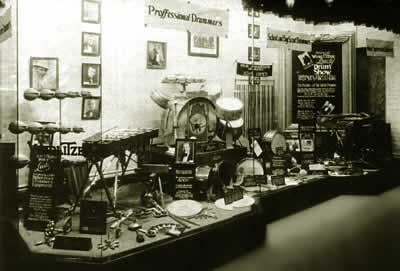
Below: Leedy Exhibit 1927:
Below: Leedy Window Display 1933:
U.G. Leedy was an excellent judge of character, and hired departmental managers who maintained his high standards. When he realized the need for a full-time sales manager, he sought out George Way. Way was at the time operating his own drum company in Canada, but Leedy convinced him to give that up and move to Indianapolis. The personable Way was not only a percussionist and salesman, but also an engineer and artist. Many of his contributions changed the percussion industry forever, such as the floating-head concept, self-aligning lug, and pearloid covering on drums. Way created a promotional publication titled Leedy Drum Topics which included playing tips, endorser news, and product introductions.
Way's concepts and rough drawings were often perfected in the engineering department by the talented Cecil Strupe. Strupe was Leedy,s chief Mechanical Engineer and shop superintendent from the early 1920s through the mid 1930s. (In 1937 Strupe left to join William F. Ludwig and William F. Ludwig II when they founded the WFL company. (As a WFL employee, Strupe developed the triple-flanged hoop.)
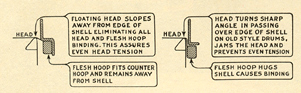
Leedy's Way invented the double-flanged hoop, resulting in the "floating head".
In the mid 1920s, both the Leedy company and the Ludwig & Ludwig company (which had by this time grown larger than Leedy in terms of gross sales) began to develop plans for manufacturing banjos. The banjo was a wildly popular instrument at the time, and it seemed at the time to be a natural move. Both firms spent fortunes gearing up for the production of elaborately carved, inlaid, and plated instruments at the worst possible time. Banjo popularity began to wane, and cash flow became something of a crisis.
U.G. Leedy's health began to fail. Knowing that the end was near and wanting to provide for his family and employees, he sold his company to the Conn company in 1929. At nearly the same time, Conn purchased the financially weakened Ludwig & Ludwig. Conn moved both companies to Elkhart where both lines of drums were produced in the same building. George Way and most of the rest of the Leedy executive staff moved to Elkhart and continued their product developments without major disruption. Wm. F. Ludwig had also moved to Elkhart, but found it difficult to work in such an arrangement, and quit to return to Chicago where he founded his own company, WFL, in 1937.
George Way continued to head up the growth and development of the Leedy Drum Company throughout the 1930s as a Conn division.
In the aftermath of WWII, which had totally disrupted Conn's drum divisions, it was decided to combine Ludwig & Ludwig with Leedy, creating the Leedy & Ludwig drum company. This new division became operational in 1951. A cornerstone product for Leedy & Ludwig was a new series of drums with a unique tuning system, the "Knob Tension" line. The concept can be attributed to George Way, although Way was not responsible for the final engineering which proved to be lacking, and the line was a spectacular and expensive failure. Knob Tension drums were discontinued within a year. Conn decided to discontinue the unprofitable Leedy & Ludwig division four years later in 1955.
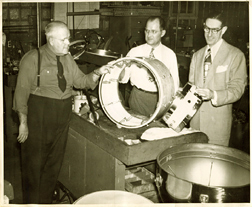
Below: Geo. Way (left) inspecting Leedy knob tension drums (1951):
Wm. F. Ludwig II (of the WFL drum company) and Bud Slingerland (of the Slingerland drum company) teamed up to make Conn an offer. The Ludwig family got the Ludwig name back, and Slingerland purchased rights to the Leedy name. Ludwig and Slingerland spent weeks going through the plant to debate the division of tools, equipment, and inventory.
Slingerland tried to introduce Leedy as a second line. They wanted to sell Slingerland drums to the top dealer in each town, and Leedy to the secondary dealers, leaving Ludwig the third-tier dealers. That plan did not work out. Except for a new lug design and badge, the Leedy drums that were produced by Slingerland from 1956 to 1965 were basically Slingerland drums. Slingerland quietly discontinued Leedy production and use of the name in the mid 1960s.
The Slingerland family sold the drum company in 1970 in what was to become the first of numerous ownership shifts over the next 25 years. Each time, the purchase agreement included the Leedy name, patents, trademarks, and parts. Each time, that is, until Fred Gretsch sold Slingerland to the Gibson company in 1994. He retained ownership of Leedy and began to consider how he could bring this once great American drum name back into the marketplace.
Recognizing the value and prestige of the Leedy name, Gretsch has taken carefully measured steps in bringing Leedy back into the marketplace. The first few drums were shown at the 2002 Nashville NAMM show where they were enthusiastically received by dealers. At the 2003 Anaheim NAMM show, 25 drums were displayed and again received an enthusiastic response. Now, through establishing the Leedy USA Custom Shop discriminating drummers can now take advantage of original Leedy products customized to deliver classic beauty and sonic perfection.
|
The history section of the Leedy website written by Rob Cook, author of The Complete History Of The Leedy Drum Company, ISBN 0-931759-74-9. This book and other drum history materials are available from Rebeats at www.rebeats.com. |
|